What Is the Tariff Rate of Beef in Australia
Marketplace admission
Red Meat 2030: market place access priorities
Improved market place admission, and the successful defense of existing gains, volition be critical in achieving manufacture's 2030 goal of doubling the value of crimson meat sales.
Fortunately, Australian red meat and livestock have access to many export markets, thank you to robust integrity systems, an unrivalled disease-gratis status, and a track record past the Australian industry in partnership with the Government in perusing preferential trade reform.
However, a large number of Australia's overseas markets remain discipline to entry barriers. These impediments to merchandise are imposed in many forms. Edge protection measures, including tariffs and quotas, are the nigh obvious. Nonetheless, non-tariff barriers and technical imposts are also major problems. While Australian exports take greatly benefited from the reduction in tariffs over the concluding three decades, not-tariff barriers tin can often prohibit the industry from fully realising those gains.
Red Meat 2030 outlines industry'southward goals in relation to market access:
- to secure preferential access in over 90% of red meat export markets; and
- to reduce the impact of non-tariff barriers by A$1 billion.
In terms of preferential admission, the Australian red meat industry's priority is to secure improved import regimes through ongoing trade negotiations with the Eu and the ratification of an agreement with the U.k.. Additional opportunities for preferential merchandise reform include improved admission to the Gulf Cooperation Council (GCC) countries, India and Taiwan.
When it comes to non-tariff reform, removing impediments in the Middle East, China and Due south East Asia are the priority.
![20MLA-Tariff-map[12].png](https://www.mla.com.au/contentassets/120908f5fdcc4861808f51cfd9e8022a/22mla-tariff-map.jpg)
*Click paradigm to enlarge
Note: equally tariff rates and quotas can alter, reference should also exist made to DFAT's FTA Portal besides every bit the tariff schedules available from the relevant dominance in the state of interest.
Acronyms: AANZFTA: ASEAN-Australia-New Zealand Free Trade Area; AUSFTA: Australia-United States Complimentary Trade Agreement; CER: Commonwealth of australia-New Zealand Closer Economic Relations; CPTPP: Comprehensive and Progressive Trans-Pacific Partnership; ChAFTA: Mainland china-Australia Free Merchandise Agreement; A-HKFTA: Australia-Hong Kong Complimentary Trade Agreement; IA-CEPA: Indonesia-Australia Economic Partnership Agreement; JAEPA: Japan-Australia Economic Partnership Agreement; KAFTA: Korea-Australia Costless Trade Understanding; MAFTA: Malaysia-Commonwealth of australia Free Trade Agreement; PAFTA: Peru-Australia Gratis Trade Agreement; RCEP: Regional Comprehensive Economic Partnership; SAFTA: Singapore-Commonwealth of australia Free Trade Agreement; TAFTA: Thailand-Australia Complimentary Trade Agreement; WTO: Globe Trade System.
The importance of market admission
As a major exporting industry, changes in access to overseas markets affect the profitability of both private livestock producers and meat processors. Approximately iii quarters of Australian red meat is now consumed in overseas markets. Access to a broad array of global markets allows Australian exporters to maximise the value of each carcase and reduce the take chances of being overly reliant on any one buyer. Dynamic international marketplace conditions require an ongoing effort to defend access and, where possible, secure improvements to consign conditions via merchandise reform.
MLA'south role in market access
MLA's market admission program, co-funded by producer levies and processor contributions, works alongside industry and government to defend and maintain existing favourable access conditions, position Commonwealth of australia positively in merchandise negotiations and assist with the alleviation of not-tariff (technical) trade barriers via in-market place representation and research.
MLA's contribution is led by staff in Sydney, and via our overseas offices in Washington, Brussels, London, Dubai, Beijing, Tokyo, Seoul, Singapore and Dki jakarta, coupled with our network of representatives in South E Asia.
Broadly speaking, MLA has a trade advocacy role.
The role of government
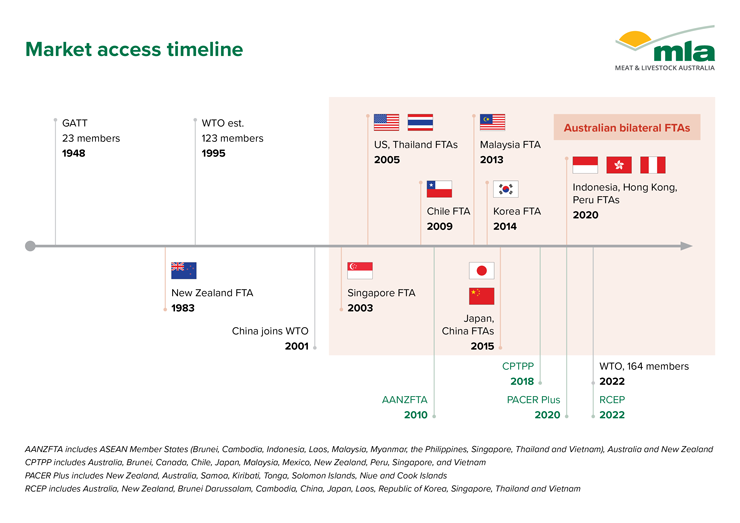
Defending market access and securing trade reform are commonly undertaken at a government-to-authorities level. In so doing, the Australian Authorities implements an integrated trade policy program with the goal of creating new and more than open up export markets. This is achieved through iii key trade reform avenues:
- Multilateral trade reform involves discussions with many countries via the Earth Merchandise Organization (WTO)
- Regional trade reform involves numerous countries within a specified region
- Bilateral trade reform involves ii countries and is advanced via free trade agreements and individual country/sector negotiations on market place access
*Click image to enlarge
Costless merchandise reform
Costless trade agreements (FTAs) or closer economic partnerships promote stronger trade and commercial ties between participating countries and open-up opportunities for Australian exporters and investors to expand their business concern into key markets. FTAs can speed up trade liberalisation by delivering gains faster than multilateral or regional processes.
The Australian cherry-red meat and livestock industry has been a major casher of FTAs completed to date. This has involved the reduction or elimination of tariffs equally well as improvements to other, previously trade restrictive, measures. For example, it is estimated that the benefits of Commonwealth of australia's the three Due north Asian FTAs – Korea (KAFTA), Japan (JAEPA) and China (ChAFTA) – will result in a combined $xx billion in actress value for the Australian industry over the next twenty years.
Furthermore, Australia'due south recent FTA with Indonesia (IA-CEPA) volition eliminate remaining tariffs imposed on Australian livestock and meat exports, while the Comprehensive and Progressive Agreement for the Trans-Pacific Partnership (CPTPP) will further liberalise cerise meat access into Japan and remove barriers in other markets.
Source: https://www.mla.com.au/marketing-beef-and-lamb/international-markets/market-access/
0 Response to "What Is the Tariff Rate of Beef in Australia"
Post a Comment